Following one of the sharpest two-day falls on record triggered by President Trump’s ‘Liberation Day’ tariff shock in early April, which left the S&P 500 index down by over 15% from the beginning of 2025, few would have predicted that by year end the bull market that began in October 2022 would be extended with another substantial double-digit calendar year return of 17.4% from US stocks, taking the cumulative total return over the last three years to 82%. Once again, the market was very narrow in 2025 and AI was the dominant theme: two stocks, Nvidia (+39%) and Alphabet (Google, +65%) contributed 30% of the annual gain and only 30% of S&P 500 stocks outperformed the index, with a total of 319 making gains, continuing the pattern of 2023 and 2024. Globally, the AI theme was reflected in two of the top three performing sectors in the MSCI World index: communication services +31% and IT +23%, with the third, financials +26%, driven by falling interest rates, steepening yield curves and benign financial conditions. In contrast, two of the three weakest performing sectors reflected a subdued consumer spending environment, Consumer Staples +6% and Consumer Discretionary +7%, leaving the quality cohort of global stocks trailing its growth, momentum, value and small cap cousins.

2025, however, was very different to the preceding two years in two important respects:
The bulk of the return in the US came from earnings growth, which surprised on the upside at 13.5%, with only 2.5% from valuation expansion, whereas multiple expansion contributed 17.3% in 2023 and 10.6% in 2024;
Non-US markets, which had underperformed substantially in 2023 and 2024, materially outperformed the US in USD terms in 2025, with the MSCI World ex US index returning 31.8%. Part of the reason was US exceptionalism being called into question as the US administration re-writes the global economic and geopolitical world order, leading to weakness in the US dollar, down by 9.5% over the year on a trade weighted basis.
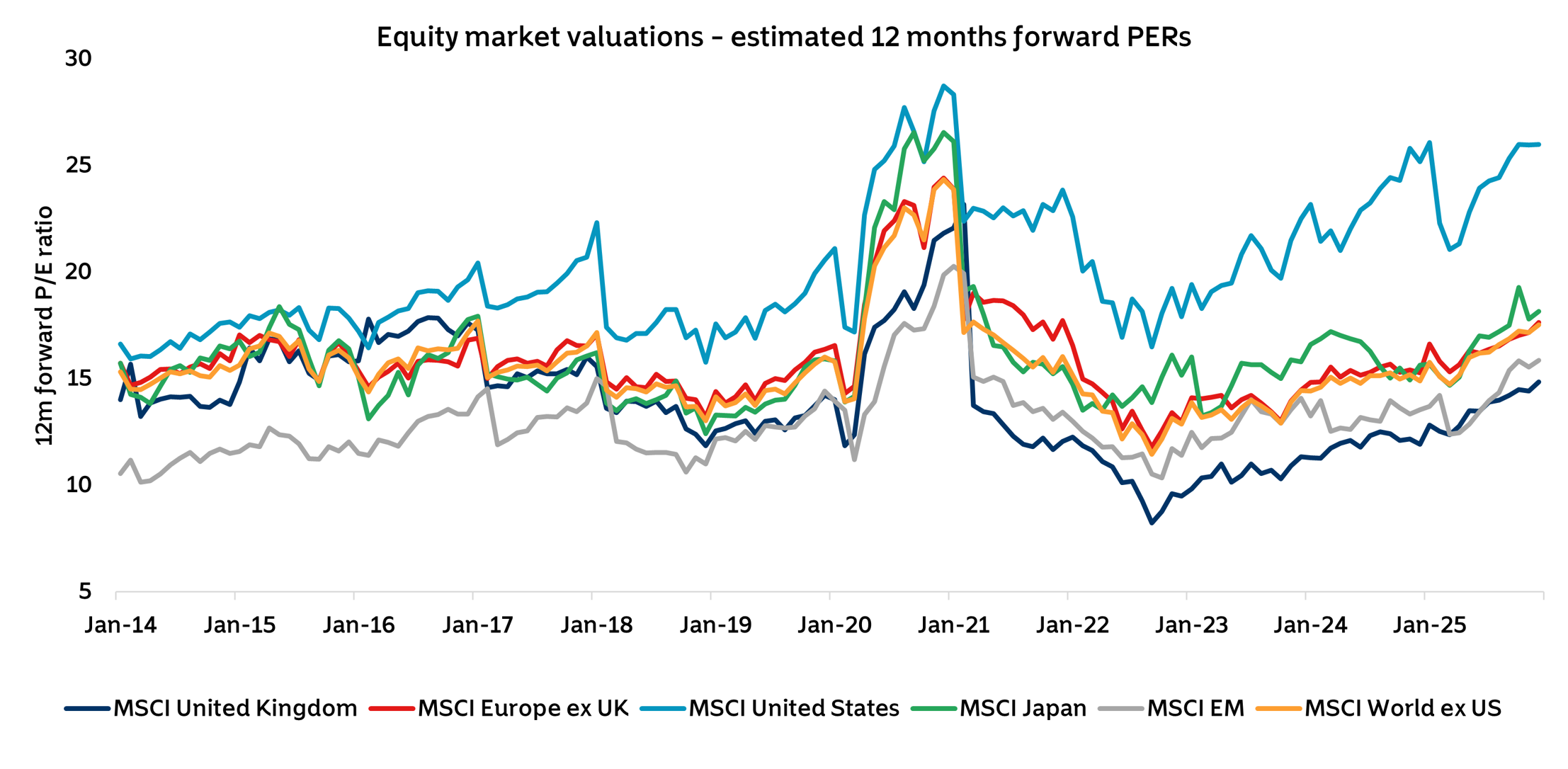
Most of the dollar’s fall occurred in the first four months of the year and was driven in part by investors diversifying their asset holdings more widely, but more by non-US investors hedging their currency exposure rather than selling US assets. In addition, valuations of US stocks, particularly those driven by the AI boom, had become increasingly extended relative to non-US stocks, which offered both better value and diversification benefits, leading to some rebalancing of portfolios. Although this pushed valuations outside the US higher during 2025, most markets still offer significantly better value than the US and further outperformance is likely during 2026. Gold, up by 61.5%, was a major beneficiary of the dollar fall as well as concerns around Fed independence, geopolitical worries and debt sustainability. Despite this high headline number, gold actually underperformed its precious metal peers, with silver and platinum both more than doubling over the year following a late year end surge. Gold and precious metal producers fared even better.
In the event, the tariff impact was substantially watered down as the US negotiated deals with most of its key trading partners, and companies proved remarkably adept in managing the uncertainty, such that economic activity was resilient, and corporate profits generally performed ahead of expectations, while by year end the inflation rate had resumed its decline, giving room for the Fed to cut its policy rate by 25bps at each of three successive meetings in the final months of the year.
This environment was supportive for bond markets, most of which delivered returns above cash, with US Treasuries +6.2% over the year. High grade credit and high yield bonds outperformed, mostly from their higher income, but the standout sector was emerging market hard currency debt, +12.4%, with the outlook for emerging markets improving through the year as the dollar weakened, US rates were cut, and tariff fears diminished.
Notable underperformers were the Japanese and Euro Government bond markets, which returned respectively –6.2% in yen terms and +0.7% in euro terms. The Bank of Japan (BoJ) is steadily normalising policy as inflation has been above its 2% target rate since April 2022, and delivered two policy rate increases of 25bps each, taking the rate to 0.75%, and its 30-Year bond yields rose by 110bps to 3.38% over the year, the highest levels reached since their launch in 1999. Although the European Central Bank (ECB) delivered four cuts of 25bps in 2025 they all came in the first half of the year; with inflation at target and growth more resilient than expected, the ECB signalled that it had probably come to the end of its easing cycle; bond yields rose over the year, with the biggest moves in longer maturities – the 30-Year German bond yield rose by 90bps to 3.47% by year end.
These moves effectively return most bond yields to normal levels after the extraordinary period of near-zero interest rates post the GFC and through the pandemic period. They now offer reasonable real yields in most markets and around fair value, likely to trade in a range in the macro conditions we expect, with little room for significant falls in rates given fiscal and debt constraints and resultant supply of sovereign bonds. They now play a role as a useful income generator and safe haven asset for multi-asset portfolios, and any significant moves in yields could provide tactical opportunities to add value.
As the differential between US rates and those of other major currencies is expected to narrow, with a commensurate fall in the costs of hedging USD exposure, further dollar weakness is likely. This will support the performance of non-US assets, and is a particular benefit to emerging markets, creating room for easier monetary policy and improving already favourable macro fundamentals. After a long period of underperformance against developed world equities, emerging equities outperformed in 2025 with a return of 33.8% in USD terms, but this still leaves their relative performance over the past 15 years substantially behind developed markets at 86% versus 392%. With relatively attractive valuations across much of the emerging market universe, we expect further outperformance in 2026.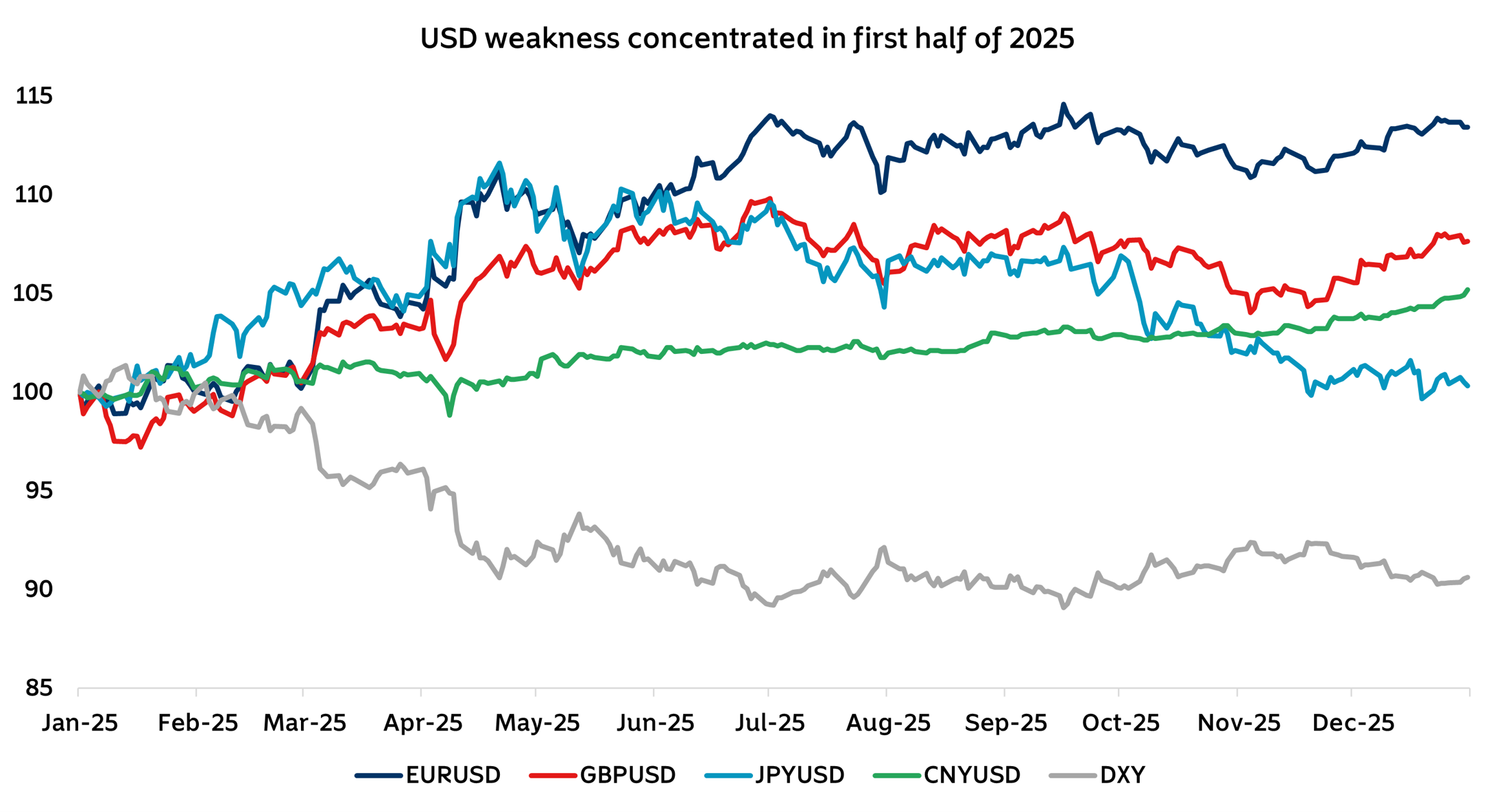
Source: Bloomberg Finance as at 7 January 2026. DXY is a USD trade weighted index.
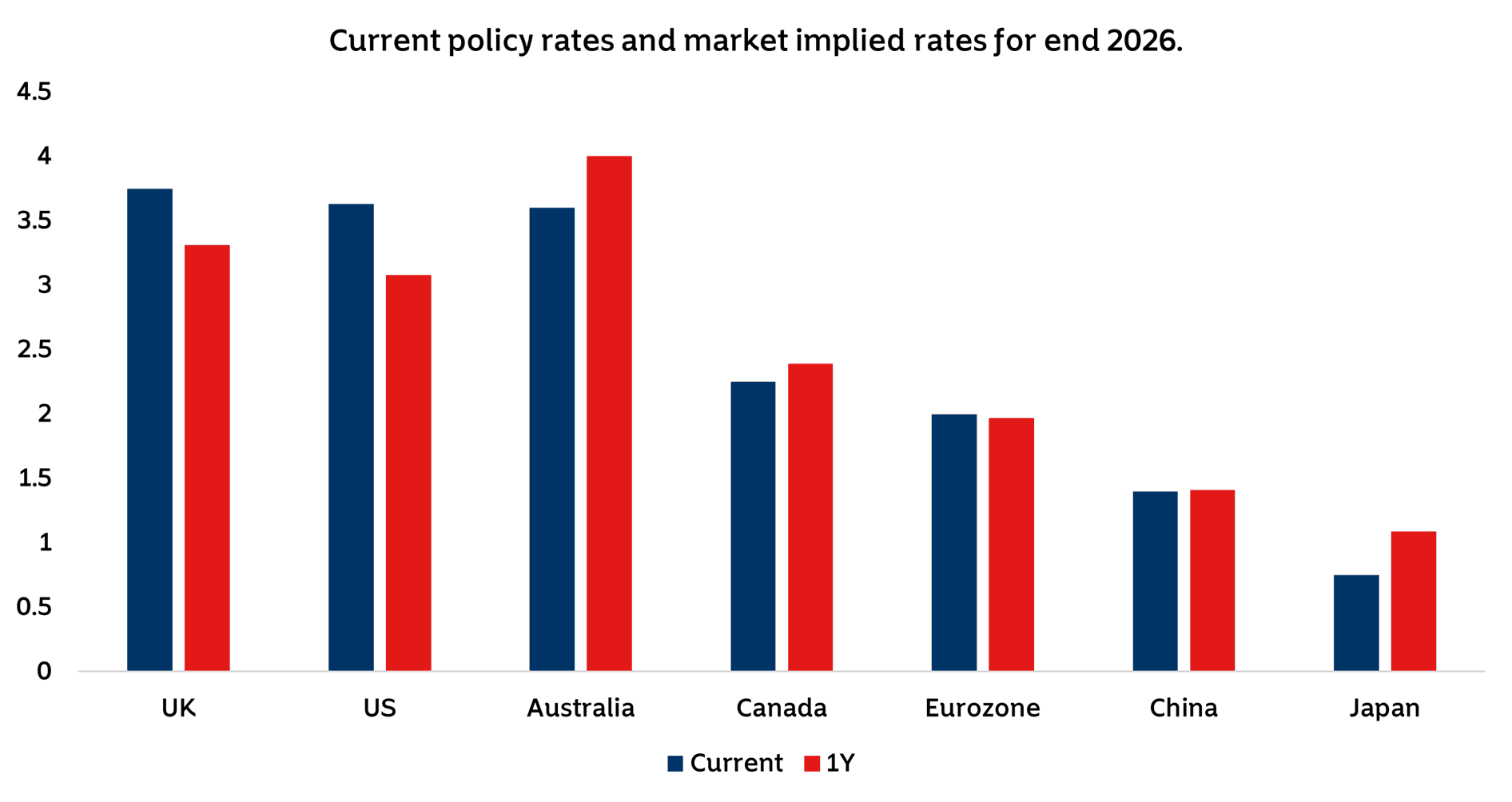
Entering 2026, macro-economic conditions, while not without risks, are broadly favourable. The fear of tariffs massively disrupting trade and supply chains has dissipated, and although the impact of higher tariffs is still working through the economy, most of the uncertainty has been discounted. Economic growth globally has been resilient and inflation has remained largely under control, close to or slightly above target rates, such that most of the monetary easing cycle is behind us. Some central banks are now on hold with policy, such as the ECB, or expected to tighten, including Japan, where policy normalisation has further to run, and Australia and Canada, where domestic economic conditions have strengthened. Importantly however, any tightening is expected to be cautious and modest, and most importantly of all, the Fed is expected to cut further in the face of a soft labour market, keeping financial conditions easy. The Bank of England is also expected to cut as inflation is set to fall closer to target and economic activity remains subdued. Fiscal policy generally is likely to support growth: in the US through tax cuts, in China where selected stimulus measures are planned, in Japan as new PM Takaichi has announced a significant stimulus package, and in Germany, where its huge defence and infrastructure commitment early in 2025 should begin to impact growth.
Source: Bloomberg Finance as at 7 January 2026.
Easier monetary conditions in the US along with the lagged impact of earlier loosening in most major economies, the fiscal boost ahead, and rising business investment especially from the boom in AI infrastructure spending as well as more traditional cyclical sectors, should offset a softer labour market and weakness in consumer spending outside the high income sector to produce a modest pick-up in growth in 2026. With household and business balance sheets healthy, and banks with particularly strong capital positions, this is a supportive backdrop for equity markets, which we expect to make further progress.
There will inevitably be periods of volatility, especially after the strong rise of markets in recent months. These could be triggered by a range of factors: geopolitical events; worries about fiscal and debt sustainability, given the size of government budget deficits and debt-to-GDP ratios across large parts of the developed world; stretched valuations, notably in the broad AI sector which has driven a substantial portion of returns (up to 50% of the S&P 500 return) over the past three years and brings considerable concentration risk given the huge size of the megacap tech stocks and concurrent passive fund buying; or increasing concerns about the sustainability of AI capital expenditure, a concern that has taken hold in recent months and taken the shine off many AI stocks, particularly those at the more speculative end. To date the main beneficiaries in terms of profitability have been the hardware providers like Nvidia and Broadcom; monetising the AI revolution and its broad adoption will be a focus of investors given the sheer scale of the investments, and this presents material upside and downside risks.
Source: Bloomberg Finance as at 7 January 2026.
Although the macro picture is clearer than for some time, there remains a high degree of uncertainty - not least on the geopolitical front - and disappointments could lead to sizeable corrections given the increased valuations across markets. On balance, however, given the broadly benign global economic and financial outlook, we are cautiously optimistic and believe it is appropriate to stay invested. But careful selection is necessary, and risks should be spread broadly across asset classes, markets and styles. The concentration of markets in a relatively small number of highly valued megacap tech stocks strengthens the case for broad diversification, and a nimble approach will be necessary to take advantage of tactical opportunities during the inevitable periods of volatility that lie ahead. But the foundations are firm enough for us to remain constructive about markets and to seek opportunities to add to risk during such periods of volatility.