 Fraser Sanderson, CFA - Investment Strategist
Just as households adjusted to the hustle and bustle of the new school year, investors were reminded that the summer calm never lasts forever, with September proving far more turbulent than the first two months of the quarter. While equities largely avoided the disorder seen across other asset classes, the bond market was centre of attention, enduring a bruising month as investors rapidly reassessed the outlook for growth, inflation and interest rates. The result was one of the sharpest rises in global government bond yields in recent years, culminating in the US 10-year Treasury yield reaching 5.20% by month end, a level not seen since before the Global Financial Crisis. The significance of September's moves extends well beyond fixed income markets. Government bond yields represent the foundation upon which virtually all asset prices are built. When yields rise sharply, investors are forced to question the valuation of equities, credit, property and infrastructure alike.
Global equities were surprisingly resilient given the scale of the bond market sell off, although performance beneath the surface was noticeably more mixed than the headline indices suggested. The MSCI World Index fell 1.3% over September, while the S&P 500 declined only 0.5%. Yet those benchmark returns mask a growing divergence between the handful of companies directly benefiting from the AI boom and much of the broader market. The S&P 500 Equal Weight Index fell 5.0%, while the Russell 2000 Index of smaller companies declined 5.4%. By contrast, the Philadelphia Semiconductor Index rose 8.9%. Investors have become relatively numb to this divergence in recent years, but the scale of the return differential between AI and the broader economy was particularly striking this month.
The question confronting investors remains the same that has dominated debate throughout 2026: is AI simply the most attractive area of the market, or has it become the only area generating meaningful growth? The answer most likely is, as is often the case in financial markets, somewhere in between. The AI investment cycle undoubtedly continues to provide powerful support to earnings growth, business investment and economic activity. Since the start of the third quarter, the Atlanta Fed's GDPNow estimate has surged from roughly 1.5% annualised growth at the end of June to approximately 5.0% today. Such a dramatic upgrade to expected growth helps explain why real bond yields have risen so significantly during the quarter. Stronger growth typically requires higher real interest rates, as businesses compete more aggressively for capital and bond investors demand greater returns to forgo increasingly attractive investment opportunities elsewhere in the economy. Investors are therefore increasingly pricing a world where economic activity remains stronger for longer and central banks have less scope to reduce interest rates in the near term.
Atlanta Fed GDPNow spiked to 5% GDP Growth
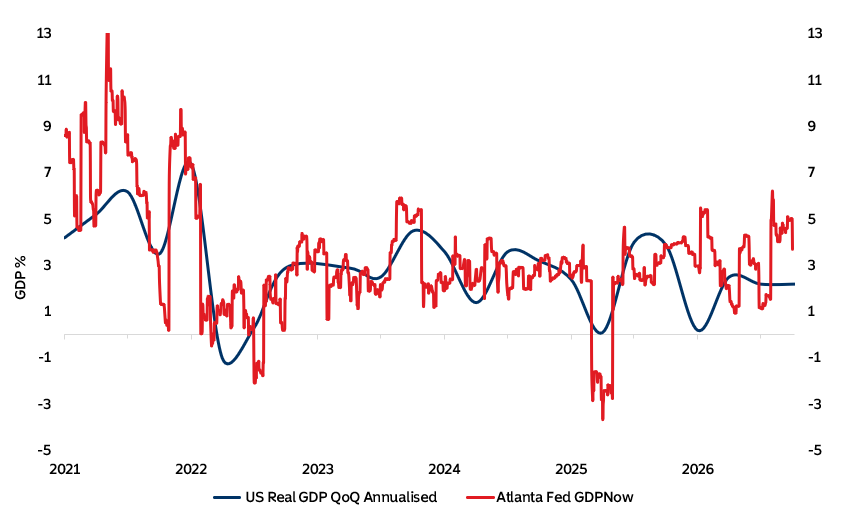
Source: Alpine Macro Research, data to 30 September 2026.
Geopolitical tensions also contributed to bond market volatility. Renewed hostilities between the United States and Iran, alongside attacks on Saudi oil infrastructure and disruptions to key energy supply routes, pushed Brent crude back above $100 per barrel and reignited concerns over global energy supplies. However, while rising oil prices provided the spark, stronger economic growth provided the fuel. Throughout the quarter, economic data consistently challenged the view that elevated interest rates would eventually weigh heavily on activity. Business surveys, labour market data and growth estimates all pointed towards an economy that remained remarkably robust despite already restrictive monetary policy. September's US composite PMI, for example, rose to 58.4 against expectations of 55.3, signalling a meaningful acceleration in activity at a time when many investors had anticipated further slowing.
Yields trend with Oil
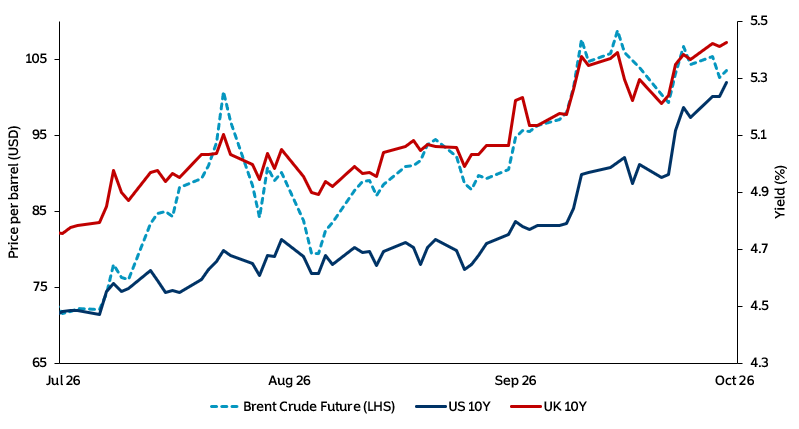
Source: Bloomberg Finance L.P., data to 30 September 2026.
Consequently, investors entered the quarter debating when central banks might begin easing policy, however they exited it contemplating whether another tightening cycle had already begun. The Federal Reserve delivered its first base rate increase since 2023 during September, while the Bank of Japan raised interest rates to 1.25%, their highest level since 1995. Futures markets quickly moved to price further rate increases over the coming year, contributing to one of the sharpest rises in bond yields seen this year. Importantly, the move was driven far more by rising real yields than rising inflation expectations. Despite the spike in oil prices, longer term inflation expectations, as measured by breakevens, remain relatively subdued, suggesting investors view the current energy shock as temporary rather than the start of a sustained inflationary cycle. Instead, markets appear to be repricing stronger growth, higher productivity and a higher path for future interest rates. In other words, investors are becoming less concerned about inflation running out of control and more concerned that the economy may simply be too strong to justify lower interest rates.
When we look at Q3 as a whole, it can in many respects be summarised as a battle between two powerful market forces. On one side sits the AI-led investment boom, which continues to drive exceptional corporate earnings, capital expenditure and economic growth. On the other sits the reality that stronger growth and higher inflation inevitably result in higher bond yields and tighter financial conditions. The key question for investors is whether the benefits of the former can continue to outweigh the headwinds created by the latter. Thus far, the AI boom does appear to be the winning force. Corporate profits have remained strong, economic activity has accelerated and equity markets have broadly remained resilient despite the significant tightening. Investor enthusiasm, however, has remained surprisingly measured considering the strength of the underlying backdrop. This caution is perhaps understandable. Beneath much of the encouraging economic data lies an increasingly uncomfortable question regarding how durable the AI build out really is and whether a market comeuppance is a matter of ‘when’, rather than ‘if’.
Indeed, one could argue that the dominant theme of the third quarter was not artificial intelligence itself, but rather the extent to which the global economy has become dependent upon it. Stronger growth, rising profits and buoyant economic data have undoubtedly been welcomed by investors, but an increasing proportion of that strength can be traced directly or indirectly to spending associated with AI infrastructure. Whether viewed through the lens of semiconductor demand, datacentre construction, power infrastructure, property development or broader business investment, the influence of AI is becoming increasingly difficult to separate from wider economic activity. Investors are understandably sceptical, as history provides numerous examples of transformative technologies generating too much investment rather than too little. Railways, telecommunications networks and the internet revolution all delivered extraordinary societal benefits whilst simultaneously producing periods of overinvestment that proved painful for investors. There is a reasonable argument that today's AI boom could eventually follow a similar pattern. That does not mean the technology is any less revolutionary. Rather, it suggests investors must be careful to distinguish between a great technology and a great investment.
Encouragingly, valuations do not currently appear obviously euphoric. Certain companies undoubtedly have substantial earnings growth embedded within their valuations, but broader market multiples remain some distance from levels historically associated with major speculative bubbles. Investor sentiment also remains relatively restrained despite the exceptional growth currently being delivered by many AI beneficiaries. Nevertheless, concentration risks are difficult to ignore. Roughly 40% of S&P 500 constituents are negative for the year despite the index remaining close to record highs. Such statistics illustrate how dependent market performance has become on a relatively small number of companies and themes. The risk is not necessarily that AI fails, but rather that expectations run too far ahead of reality. Given the scale of investment currently taking place, even a modest disappointment could reverberate across multiple asset classes. Evidence of this interconnectedness was apparent during September's bond market weakness. Listed property and infrastructure, often viewed as long duration assets due to the timing of their expected cash flows, suffered alongside government bonds. Global listed property fell 5.8% during the month while listed infrastructure declined 5.7%, highlighting how many asset classes have become sensitive to the same underlying drivers of growth, inflation and interest rates.
Narrow S&P signals underlying weakness
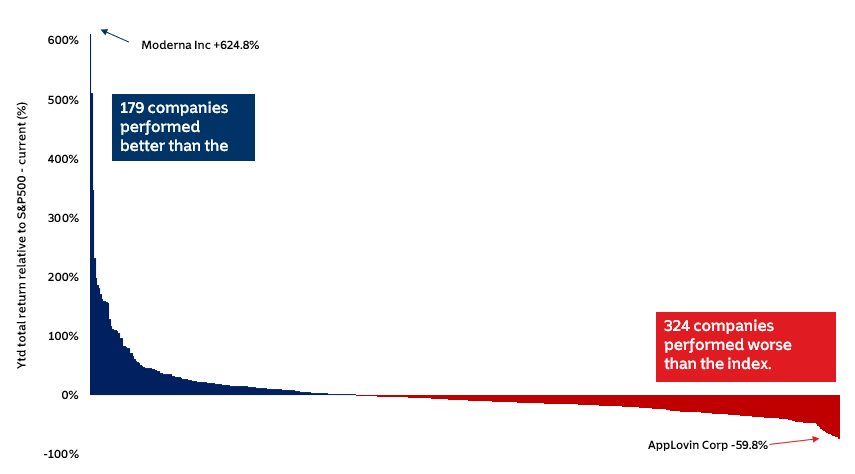
Source: Bloomberg Finance L.P., data to 13 October 2026.
Looking ahead, investors will increasingly turn their attention toward the US midterm elections, which will determine control of Congress for the final two years of President Trump's term. Markets appear to be increasingly focused on the possibility of a divided government and the checks and balances such an outcome would impose. Historically, periods of political gridlock have not necessarily been unfavourable for investors, although the economic implications are often difficult to predict with confidence. As we progress into the final quarter of the year, the outlook remains finely balanced. Economic growth is accelerating, corporate profitability remains robust and the AI investment cycle continues to gather pace. Yet borrowing costs have risen sharply, geopolitical risks remain elevated and large sections of financial markets have become heavily dependent on a single theme continuing to deliver.
The challenge for investors is therefore not deciding whether AI will be transformative. It almost certainly will be. The challenge is determining how much of that future success is already reflected in asset prices, while ensuring portfolios remain resilient should the current build-out prove more cyclical than structural. With many asset classes increasingly responding to the same underlying forces, maintaining exposure to genuinely differentiated sources of return remains one of the most effective tools available to long term investors, should they know where to look.